
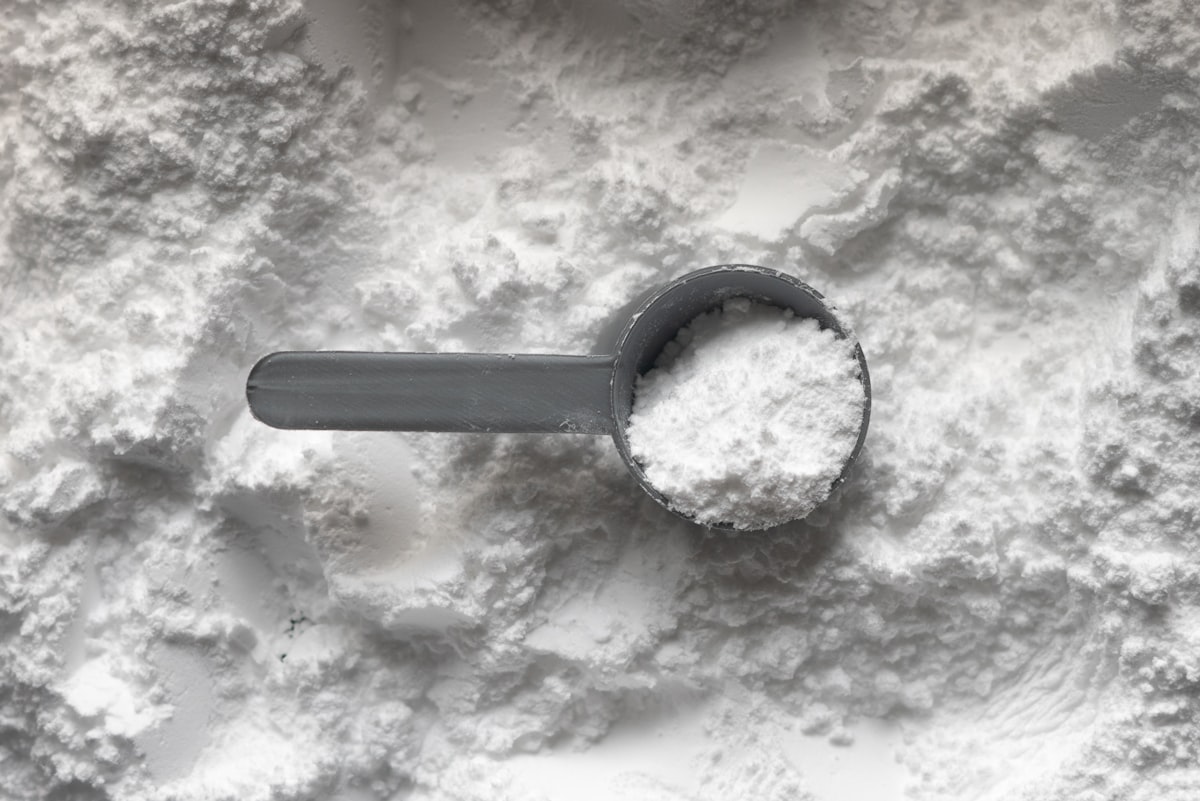
If you're only going to take one supplement, make it creatine. That's not a marketing slogan — it's a conclusion supported by over 500 peer-reviewed studies conducted across the last three decades. No other legal performance supplement comes close to creatine's combination of safety, efficacy, and scientific backing. Yet myths about kidney damage and water retention continue to circulate. This guide covers the real science.
What Is Creatine?
Creatine is a naturally occurring compound synthesised in the body from three amino acids: arginine, glycine, and methionine. About 95% of your body's creatine is stored in skeletal muscle, with the remainder in the brain and other tissues. You also obtain small amounts through food — primarily red meat and fish — but dietary intake alone typically provides only 1–2 grams per day, well below the levels associated with performance benefits.
The mechanism is elegant and well-understood. During intense, short-duration exercise — sprinting, heavy lifting, explosive movements — your muscles rely on adenosine triphosphate (ATP) for energy. ATP is depleted within a few seconds. The phosphocreatine system replenishes ATP rapidly by donating a phosphate group to adenosine diphosphate (ADP), regenerating ATP. By increasing the phosphocreatine reservoir in your muscles through supplementation, you extend the duration of this high-power energy system, allowing you to train harder before fatigue forces a slowdown.
The Evidence: What 500+ Studies Show
The research literature on creatine is extraordinary in its breadth. A 2003 meta-analysis of 22 trials found that creatine supplementation produced an average 8% increase in maximal strength, findings corroborated by the NIH Office of Dietary Supplements on exercise and athletic performance and a 14% improvement in explosive power compared to placebo. Subsequent research has consistently confirmed gains in the range of 5–15% for strength outcomes, with higher improvements typically seen in beginners.
For muscle mass, creatine works through multiple pathways: greater training volume (you can do more reps, more sets), increased intramuscular water retention that drives anabolic signalling, and possible direct stimulation of satellite cells — the muscle stem cells responsible for repair and growth. Studies measuring lean mass gains over 4–12 weeks routinely show 1–3 kg more muscle gained with creatine versus placebo when training is matched.
Creatine and Brain Health
The brain is an energy-hungry organ, and creatine's role in ATP regeneration extends beyond muscle. A growing body of research — including a compelling 2022 study in Nutrients — found that creatine supplementation improved cognitive performance under sleep deprivation and in older adults. A meta-analysis of 6 randomised controlled trials found significant improvements in memory tasks among healthy adults taking creatine. The effect is particularly notable in vegetarians and vegans, whose dietary creatine intake is near zero.
"Creatine is one of the few supplements where the evidence genuinely warrants recommending it to the general population — not just athletes. The safety record after 30 years of research is exceptional." — Dr. Richard Kreider, Exercise and Sport Nutrition Lab, Texas A&M University
Types of Creatine: Monohydrate vs the Alternatives
Walk into any supplement shop and you'll find creatine marketed under a dozen different forms — creatine HCl, ethyl ester, buffered creatine, kre-alkalyn, and more. The marketing claims range from "better absorption" to "no bloating" to "superior bioavailability." The science tells a different story.
Creatine Monohydrate
This is the original form, the most studied form, and — by every head-to-head comparison — the form that works. Absorption rates are high, the cost per gram is the lowest of any variant, and the safety record spans decades. Micronised creatine monohydrate (simply a finer particle size) dissolves more easily in water but is otherwise identical.
Creatine HCl and Ethyl Ester
Creatine hydrochloride is marketed as requiring a smaller dose due to better solubility. The solubility claim is partially true in test tubes — but human absorption studies have not shown meaningful superiority over monohydrate at effective doses. Creatine ethyl ester has actually performed worse than monohydrate in direct comparisons; it converts to the waste product creatinine more readily in the gut, meaning less reaches the muscle.
The verdict: buy creatine monohydrate. The premium charged for alternative forms is not justified by the evidence.
The Loading Phase Debate
For decades, sports nutrition textbooks recommended a loading phase: 20 grams per day (split into four 5g doses) for 5–7 days, followed by a 3–5g daily maintenance dose. The rationale was saturating muscle creatine stores quickly. Technically, this works — stores do saturate faster.
What the marketing around loading fails to mention: you reach the same saturated state in 3–4 weeks by simply taking 3–5g daily. The endpoint is identical; only the time to get there differs. For most people without a competitive event in the next two weeks, there is no reason to load. Loading also increases the likelihood of gastrointestinal discomfort — the main side effect some people experience with creatine.
If you do have a specific short-term goal (a powerlifting meet in 10 days, for example), a brief loading phase is a reasonable choice. Otherwise, skip it.
Timing: Does It Matter?
Supplement companies have tried hard to make timing a selling point — pushing "post-workout creatine" products at a premium. The research is less dramatic. A 2013 study in the Journal of the International Society of Sports Nutrition found a modest advantage for post-workout creatine consumption, but subsequent studies have not consistently replicated this. The current consensus is that consistency of daily intake matters far more than the exact timing. Take it whenever it fits your routine — with a meal, with a shake, morning or evening. The muscle saturation effect is cumulative and not acutely time-sensitive.
Who Benefits Most from Creatine?
Creatine benefits virtually everyone who takes it, but certain groups see the most dramatic results:
- Beginners: People new to strength training experience the largest absolute strength and muscle gains, and creatine amplifies this "newbie gains" window considerably.
- Vegetarians and vegans: Because plant-based diets contain no dietary creatine, muscle stores in vegans are significantly lower at baseline. Supplementation produces larger performance improvements in this group than in meat-eaters — sometimes double the effect size seen in omnivores.
- Older adults: Research published in Medicine and Science in Sports and Exercise found creatine supplementation alongside resistance training improved lean mass and functional strength in adults over 55, consistent with NIH ODS supplement safety guidelines, helping to counter sarcopenia (age-related muscle loss).
- High-intensity athletes: Sprinters, team sport players, and anyone doing repeated short bursts of maximal effort benefits most from the ATP replenishment mechanism.
Safety: Is Creatine Hard on Your Kidneys?
This myth has remarkable staying power despite being thoroughly debunked. It originated from a single 1998 case report of a young man with pre-existing kidney disease whose condition worsened while taking creatine — a sample size of one, in a person already compromised. Since then, multiple long-term studies in healthy individuals — including trials extending 4–5 years — have found no evidence of kidney damage. Creatine does raise serum creatinine (a metabolic byproduct), which can make routine kidney function tests appear abnormal — a finding well-documented in the NIH ODS exercise performance factsheet. This is a measurement artefact, not organ damage. Healthcare providers who are unaware that a patient takes creatine may misinterpret the result.
If you have pre-existing kidney disease, speak to your doctor before supplementing with anything. For healthy individuals, the evidence is unequivocal: creatine at standard doses is safe for long-term use.
Daily dose: 3–5g of creatine monohydrate
Loading phase: Not necessary — optional if you want faster saturation
Timing: Any time of day — consistency is what matters
Form: Creatine monohydrate (plain or micronised)
With what: Works fine with water, but some research suggests slightly better uptake with carbohydrates
Cycling: No need to cycle on and off — daily use is supported by research
The Bottom Line
Creatine monohydrate is the most evidence-backed performance supplement available without a prescription. More than 500 studies spanning three decades confirm meaningful improvements in strength (5–15%), power, muscle mass, and increasingly, cognitive performance — particularly in older adults and those eating plant-based diets.
The practical prescription is simple: 3–5g daily, any time, any form of creatine monohydrate. If you are building a supplement stack, consider pairing creatine with a quality protein powder and reviewing our guide to pre-workout supplements. No loading required, no cycling required, no premium "advanced" formula required. The supplement industry has spent years trying to reinvent creatine with more expensive variants — none of which outperform the original in rigorous research. Always consult a healthcare professional before starting any new supplement regimen, particularly if you have existing health conditions.